Terapiyalar
Information on therapies for those with DEEs
Təqdimatlar
Deus forma auroram sine volucres mixta frigore. Formas persidaque praebebat pendebat. Caesa consistere vis fratrum suis locis.
Tools & Resources
Deus forma auroram sine volucres mixta frigore. Formas persidaque praebebat pendebat. Caesa consistere vis fratrum suis locis.
Adaptive Equipment
Deus forma auroram sine volucres mixta frigore. Formas persidaque praebebat pendebat. Caesa consistere vis fratrum suis locis.
In collaboration with CDKL5 In Color
Curious about using real food through a feeding tube? In this beginner-friendly webinar, pediatric dietitian Hilarie Geurink, RD, covers the basics of blenderized tube feeding, including potential benefits, getting started safely, equipment, nutrition, and practical tips for families.
You’ll also hear from caregivers Jamie Chong, Marissa Bishop, and Melanie Kandzierski, who share their real-life experiences, lessons learned, and what they wish they had known when getting started. Whether you’re considering an occasional blended meal or a bigger transition, this webinar offers practical information to help you explore what may work for your family.
DEEP submitted formal comments to the Office of Management and Budget (OMB) in response to its proposed revisions to federal financial assistance rules (Docket OMB‑2026‑0034). These changes, if implemented, would significantly weaken independent scientific peer review, restrict essential disparities and community‑engaged research, limit international collaboration, and create new barriers for the high‑risk/high‑reward science that drives progress in rare epilepsies and the more than 10,000 rare diseases.
As a caregiver‑led collaborative representing more than 60 rare epilepsy and neurodevelopmental disorder organizations, DEEP submitted comments to ensure the concerns of families, researchers, clinicians, and industry partners are clearly heard. Our community depends on federal research programs that protect scientific integrity, encourage innovation, and support collaboration across institutions and borders. The proposed OMB rule threatens these foundations.
In our submission, we urged OMB to:
- Preserve independent scientific peer review — the gold standard of federal research
- Protect disparities research, community‑engaged science, and DEI activities essential to understanding rare disease impact
- Safeguard international collaboration critical for ultra‑rare disorders
- Maintain transparency and predictability in federal grantmaking
- Ensure agencies retain flexibility to support high‑risk/high‑reward science
DEE and rare epilepsy families cannot afford setbacks in scientific progress. DEEP will continue advocating to ensure federal policies strengthen — not undermine — the research pathways that lead to the first treatments for catastrophic childhood epilepsies.
The FDA recently proposed guidance that will help establish a “Plausible Mechanism Framework” for individualized therapies for those with specific genetic, cellular, and molecular abnormalities.The framework seeks to facilitate faster development of new treatments in cases where standard data collecting practices are unavailable. Families living with DEEs are committed partners in research and therapy development and we were pleased to submit formal comments to the FDA to ensure effective patient/caregiver engagement in implementation of the guidance. The FDA explains that approval of an individualized therapy should be supported by evidence demonstrating that the therapy is safe, effective, and can be manufactured to appropriate quality standards. This includes evidence showing the therapy is safe for patients, improves outcomes or changes the course of the disease, can be consistently manufactured and meets quality standards.
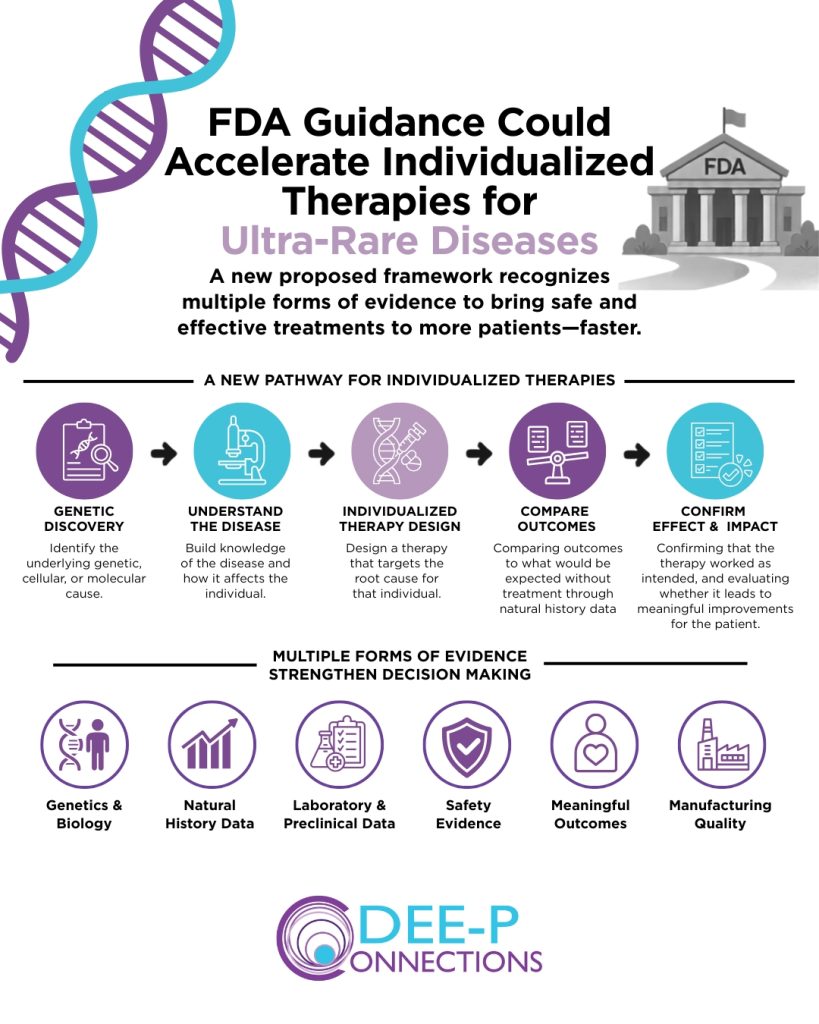
Rather than requiring the same large clinical trials used for more common conditions, which presents major challenges for rare disease populations like the DEEs, the proposed framework allows the FDA to evaluate individualized therapies using a broader set of evidence. This includes consideration of evidence on the biological cause of a disease, designing a therapy that directly addresses that cause, comparing outcomes to what would be expected without treatment through natural history data, confirming that the therapy worked as intended, and evaluating whether it leads to meaningful improvements for the patient.
DEEP comments to the FDA supports efforts to establish a new Plausible Mechanism Framework and offers additional recommendations to ensure the guidance is effective and equitable for the DEE/IDD community. DEEP’s recommendations focused on making individualized therapy development more reflective of the realities of families living with DEEs, including:
- Recognizing caregiver expertise and community-generated data as valuable sources of evidence that can help fill gaps when traditional clinical data are limited.
- Encouraging flexible, family-centered research approaches that reduce participation barriers and make studies more feasible for small and medically complex populations.
- Ensuring therapies are evaluated using meaningful outcomes and supported by realistic plans for long-term follow-up, access, and affordability.
This new framework has the potential to accelerate the future of individualized therapies for genetic conditions and open doors for new treatments for DEE patients. For families in our community, meaningful progress depends on research systems that recognize and value caregiver expertise, accommodate medical complexity/fragility, and measure small but meaningful outcomes (“inchstones”) that matter. We are grateful for the FDA’s work on this issue and were pleased to provide comments and recommendations to ensure patient/caregivers generally and the specific DEE voice is meaningfully integrated into the new framework. We urge the FDA to adopt DEEP’s recommendations and suggested edits to ensure the guidance is practical, equitable, and centered on outcomes that matter to people living with DEEs. We are excited for the promising future of individualized gene therapies as the FDA continues to develop and implement this draft guidance into an established regulatory framework.
To read our full comment and stay involved in work like this, click here.
- Caragh Maloney, DEEP Intern and caregiver to Jordan (who has an undiagnosed DEE)
Follow our socials to stay updated on work like this!
Sign up for our newsletter to be involved in future advocacy efforts!
Do you have topics you want to see covered in future blog posts? Make a suggestion here!
Navigating emerging treatment options can feel overwhelming, especially when families are asked to make decisions about experimental or individualized therapies. In this educational webinar, DEEP and KCNT1 Epilepsy explore the fundamentals of antisense oligonucleotide (ASO) therapies and the critical role of informed consent in rare disease care.
The session features an overview from Dr. Olivia Kim-McManus, who explains what ASOs are, how they work, where they fit within today’s treatment landscape, and key considerations for families as they evaluate potential treatment opportunities. The webinar also includes a parent panel sharing firsthand experiences with learning about ASOs, weighing risks and benefits, asking difficult questions, and navigating complex medical decisions.
Whether you’re new to ASOs or looking to better understand the informed consent process, this webinar offers practical education and real-world perspectives to help caregivers feel more informed and empowered.
Resources Included:
- Webinar recording
- Presentation slides
- Additional resources related to ASOs and informed consent
What happens when seizures escalate? How do you know the difference between seizure clusters and status epilepticus, and why does it matter?
In this educational webinar recording, we explore the key differences between acute repetitive seizures (seizure clusters) and status epilepticus, two conditions that can look similar but may require different approaches to treatment and emergency care. Our clinicians discuss seizure patterns, common triggers, rescue medications, and current thinking around management strategies.
We also dive into a challenge many caregivers know too well: repeated hospital visits, heavy sedation, and the difficult cycle of seizures, medications, sleep, and recurrence. This conversation aims to help families better recognize what may be happening, ask informed questions, and advocate confidently during critical moments.
✨ In partnership with FamilieSCN2A Fondu, this webinar features expert clinicians:
• Dr. Laura McGarry, MD, PhD – Children’s Hospital of Philadelphia ENGIN Clinic
• Dr. Inna Hughes, MD, PhD – University of Rochester Medical Center
Alongside parent voices, Renee, Tara, and Katie sharing lived experience navigating complex epilepsy care.
We hope this conversation helps caregivers feel more informed, empowered, and supported in making decisions for their loved ones.
Recent Projects




Client Love

David Quest
Deus forma auroram sine volucres mixta frigore. Formas persidaque praebebat pendebat. Caesa consistere vis fratrum suis locis! Silvas campoque terras coeptis homo rudis fronde.

Jennifer Barrett
Deus forma auroram sine volucres mixta frigore. Formas persidaque praebebat pendebat. Caesa consistere vis fratrum suis locis! Silvas campoque terras coeptis homo rudis fronde.
Questions about getting started? Drop us a line to find out more!
Effervescere quicquam tepescunt tegi agitabilis mentes mutatas.