
FDA Guidance To Accelerate Individualized Therapies for Ultra-rare Diseases
The FDA recently proposed guidance that will help establish a “Plausible Mechanism Framework” for individualized therapies for those with specific genetic, cellular, and molecular abnormalities.The framework seeks to facilitate faster development of new treatments in cases where standard data collecting practices are unavailable. Families living with DEEs are committed partners in research and therapy development and we were pleased to submit formal comments to the FDA to ensure effective patient/caregiver engagement in implementation of the guidance. The FDA explains that approval of an individualized therapy should be supported by evidence demonstrating that the therapy is safe, effective, and can be manufactured to appropriate quality standards. This includes evidence showing the therapy is safe for patients, improves outcomes or changes the course of the disease, can be consistently manufactured and meets quality standards.
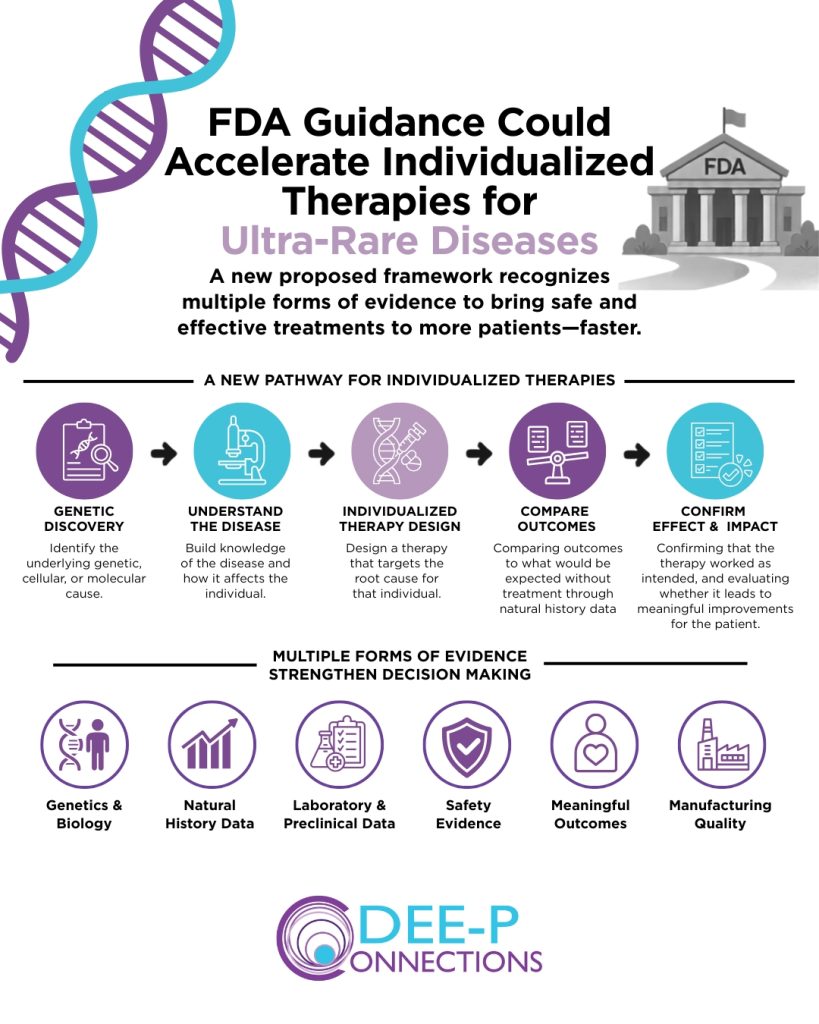
Rather than requiring the same large clinical trials used for more common conditions, which presents major challenges for rare disease populations like the DEEs, the proposed framework allows the FDA to evaluate individualized therapies using a broader set of evidence. This includes consideration of evidence on the biological cause of a disease, designing a therapy that directly addresses that cause, comparing outcomes to what would be expected without treatment through natural history data, confirming that the therapy worked as intended, and evaluating whether it leads to meaningful improvements for the patient.
DEEP comments to the FDA supports efforts to establish a new Plausible Mechanism Framework and offers additional recommendations to ensure the guidance is effective and equitable for the DEE/IDD community. DEEP’s recommendations focused on making individualized therapy development more reflective of the realities of families living with DEEs, including:
- Recognizing caregiver expertise and community-generated data as valuable sources of evidence that can help fill gaps when traditional clinical data are limited.
- Encouraging flexible, family-centered research approaches that reduce participation barriers and make studies more feasible for small and medically complex populations.
- Ensuring therapies are evaluated using meaningful outcomes and supported by realistic plans for long-term follow-up, access, and affordability.
This new framework has the potential to accelerate the future of individualized therapies for genetic conditions and open doors for new treatments for DEE patients. For families in our community, meaningful progress depends on research systems that recognize and value caregiver expertise, accommodate medical complexity/fragility, and measure small but meaningful outcomes (“inchstones”) that matter. We are grateful for the FDA’s work on this issue and were pleased to provide comments and recommendations to ensure patient/caregivers generally and the specific DEE voice is meaningfully integrated into the new framework. We urge the FDA to adopt DEEP’s recommendations and suggested edits to ensure the guidance is practical, equitable, and centered on outcomes that matter to people living with DEEs. We are excited for the promising future of individualized gene therapies as the FDA continues to develop and implement this draft guidance into an established regulatory framework.
To read our full comment and stay involved in work like this, click here.
- Caragh Maloney, DEEP Intern and caregiver to Jordan (who has an undiagnosed DEE)
Follow our socials to stay updated on work like this!
Sign up for our newsletter to be involved in future advocacy efforts!
Do you have topics you want to see covered in future blog posts? Make a suggestion here!